Cooling pillow guide
Why Your Pillow Gets Hot at Night
The pillow is usually only one part of the problem. Heat builds up through the cover, core, pillowcase, mattress climate, and room humidity.
Quick answer
For why does my pillow get hot at night, the useful answer is to solve feel, support, heat, care, and trial risk without creating a worse tradeoff. Best fit: shoppers who want a soft, supportive Cloud Pillow feel while still checking height, heat, care, and trial fit. Lumuwala Cloud Pillow is worth considering when you want a plush support feel, cooler sleep surface, and a current-policy home trial. Skip it if you need an ultra-firm contour pillow, an extremely low pillow, or a medical recommendation rather than a comfort trial.
Founder and primary Lumuwala byline
Buying brief
Decide before you shop.
Best fit
Best fit: shoppers who want a soft, supportive Cloud Pillow feel while still checking height, heat, care, and trial fit.
Skip if
Skip it if you need an ultra-firm contour pillow, an extremely low pillow, or a medical recommendation rather than a comfort trial.
Heat source
Decide whether the main problem is feel, support, heat, care, and trial risk.
Air and moisture path
Look for a breathable cover, lighter case, and less face-burying contact.
Height stability
A cooler pillow still fails if it leaves the head too low or too high.
Home test
Judge after several normal nights when the pillow has warmed up fully.
Try the Lumuwala fit
Cloud Pillow is the product this guide points back to.
Lumuwala fits the why does my pillow get hot at night search when the buyer wants cooling comfort tied to pillow height, not just a chilly first touch. It is strongest for shoppers who rotate between side and back sleep and want to test the heat story at home.
See if Cloud Pillow fits hot sleepersCluster links
Keep reading in this sleep path.
Your pillow gets hot when heat has nowhere to go
A pillow does not create much heat by itself. You do. Your head, neck, and face are warm, and they sit on the same small surface for hours. If the cover, fill, case, and bedding around the pillow do not let heat and moisture move away, the pillow starts feeling stale. The room can be perfectly quiet and dark, and the pillow can still wake you up because the microclimate around your head has gone sticky.
This is why the hot-pillow problem often shows up halfway through the night. At bedtime, the surface is cool. After a few sleep cycles, the pillow has absorbed body heat, the case may be damp, and the room may be warmer than it felt when you got in. You flip the pillow because the unused side has not been loaded yet. That helps for a moment. Then the same heat loop starts again.
The room and bed climate set the ceiling
Sleep-temperature research is blunt about the bigger picture. The thermal environment affects sleep, and heat exposure in normal bedding conditions can increase wakefulness and reduce deeper sleep stages. If the bedroom stays warm, humid, or poorly ventilated, a cooling pillow has to work uphill. It can improve the pillow surface, but it cannot move all the heat in the room.
The bed climate matters too. Heavy duvets, foam mattresses, waterproof protectors, and thick synthetic pillowcases can trap warmth around the body. That can make the pillow feel guilty even when the mattress or bedding is doing much of the trapping. A useful fix starts by asking where heat leaves the bed, not just which surface feels cold for the first two minutes.
- If the room is warm at bedtime, the pillow starts with less cooling reserve.
- If humidity is high, sweat evaporates more slowly and the pillow feels clammy.
- If the pillowcase is dense or moisture-resistant, the cover underneath has less chance to breathe.
- If the mattress and duvet trap heat, the sleeper may blame the pillow because the head notices discomfort first.
Try the Lumuwala fit
Cloud Pillow is the product this guide points back to.
Lumuwala fits the why does my pillow get hot at night search when the buyer wants cooling comfort tied to pillow height, not just a chilly first touch. It is strongest for shoppers who rotate between side and back sleep and want to test the heat story at home.
Test the cooling setup at homeCover, case, and core can fight each other
A pillow can have a breathable cover and still sleep warm under the wrong pillowcase. It can have a cooling gel layer and still feel stuffy if the core is dense and the case holds moisture. It can be made from an airy fill and still feel too hot if the sleeper compresses it flat. The parts have to work together.
Start with the layer you can change tonight: the pillowcase. A lighter cotton, linen, or other breathable case can make a bigger difference than people expect. Then check the protector. Waterproof or allergy protectors may be useful, but some versions block airflow. Finally, check the core. Solid foam needs ventilation and a good cover. Loose or shredded fill needs enough loft and regular fluffing so it does not pack down into a warm mat.
The wrong height can make heat feel worse
Pillow height is usually discussed as a neck issue, but it has a heat side too. If a side sleeper's pillow is too low, the head may sink and press more skin into the pillow. If the pillow is too high, the neck can rotate and the sleeper may keep shifting to escape pressure. Both patterns create more friction, more face contact, and more awakenings. The pillow feels hot because it is hot, and because the body is annoyed by the position.
Pillow-design research supports taking shape and height seriously for spinal alignment and waking symptoms. That does not mean height solves overheating by itself. It means a cooling fix that ruins alignment is not a fix. For hot sleepers, the goal is boring but hard: enough height to keep the neck neutral, enough softness to avoid pressure, and enough ventilation to keep the surface from going stale.
Keep a small troubleshooting log
This sounds fussy, but it works: for one week, note bedtime room feel, blanket weight, pillowcase, wake-up time, and whether the pillow felt hot, damp, flat, or too firm. You are looking for a pattern, not a perfect sleep study. If the pillow is hot only on humid nights, moisture is probably the weak link. If it is hot every night with one particular pillowcase, start there. If it is hot after you roll to your side, height and pressure deserve attention.
The log also stops you from changing everything at once. People often buy a new pillow, switch sheets, run the fan, lower the thermostat, and replace the duvet in the same week. Then they cannot tell which change mattered. Change one layer for two or three nights. Keep the parts that help. Remove the parts that only make bedtime more complicated.
Use plain notes, not a wearable dashboard. A line like pillow hot at 2:40, neck fine, shirt damp is enough. Another line like pillow cool, woke when blanket felt heavy points away from the pillow. After a week, the pattern is usually visible. You either have a surface problem, a core problem, a room problem, or a fit problem.
- Fast heat: surface, pillowcase, or protector.
- Late-night heat: core, room temperature, humidity, or heavy bedding.
- Heat plus neck pressure: height, firmness, or too much face contact.
- Heat plus dampness: moisture movement matters more than cool-touch feel.
Try the no-new-pillow fixes first
Before buying a new pillow, strip the sleep setup down for three nights. Use a lighter pillowcase. Remove any heavy pillow protector unless you need it medically or for allergy control. Wash the case and cover so skin oils are not blocking the fabric. Drop the room temperature earlier, not at the minute you climb into bed. Switch to a lighter blanket if your torso is overheating and sending sweat up toward the pillow.
Then watch the timing. If the pillow feels hot within ten minutes, the surface and case are likely the problem. If it gets hot at 3am, the core, room, bedding, or humidity is probably involved. If it feels hot only when you sleep on one side, height and pressure may be part of it. The timing tells you which layer to change first.
One more low-cost check: rotate the pillow 180 degrees for a night and sleep on the less-used edge. Older pillows often pack down unevenly. If one end feels warmer or flatter, the problem may be age and compression rather than a bad cooling concept. That is useful because it separates a worn-out pillow from a material category you might otherwise avoid forever. A flat spot can trap warmth because it removes the tiny air spaces the pillow used to have. That is repairable only up to a point. Do not ignore it.
When a cooling pillow is worth it
A new cooling pillow is worth considering when the simple fixes help but do not hold. That usually means the old pillow is too dense, too packed down, too high-contact, or wrapped in materials that do not let moisture move. Look for a cooling claim that names the mechanism: breathable cover, gel infusion, ventilated structure, phase-change surface, or a fill that can keep air moving.
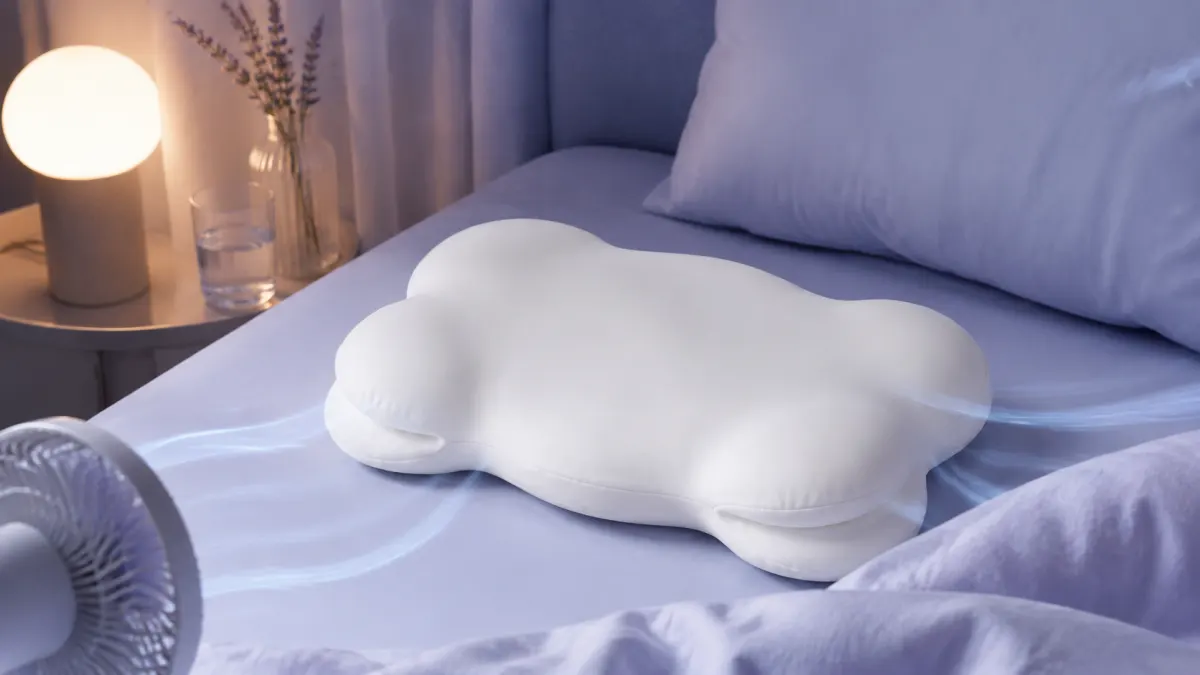
Lumuwala Cloud Pillow is a fit for the sleeper who wants cooling and support in the same purchase. Its gel-infused memory foam and breathable cover address the heat path at the pillow, while the medium-firm 6 inch shape keeps the fit conversation practical for side, back, and combination sleepers. The honest boundary is this: if the room is hot and humid, fix the room too. If the pillow is the weak layer, replace it with a design that has more than a cold first touch.
Where Cloud Pillow does and does not fit
Good fit
Lumuwala fits the why does my pillow get hot at night search when the buyer wants cooling comfort tied to pillow height, not just a chilly first touch. It is strongest for shoppers who rotate between side and back sleep and want to test the heat story at home.
Not the fit
Lumuwala is not the right fit for every why does my pillow get hot at night shopper. Do not buy it as a substitute for medical care, as a rigid prescription contour, or as a promise that a pillow alone can fix the room, mattress, or health factors behind poor sleep.
Questions shoppers ask
What is the quick answer for why does my pillow get hot at night?
Focus on feel, support, heat, care, and trial risk. The right pillow should solve that main job while keeping height, heat, care, and return risk in balance.
Where does Lumuwala Cloud Pillow fit in why your pillow gets hot at night?
It fits when you want a soft support pillow to test at home with the current policy details in view and you are not looking for a rigid medical contour.
Will a cooling pillow stay cold all night?
No honest pillow stays cold all night. A better goal is slower heat buildup, better moisture handling, and fewer wakeups to flip or rebuild the pillow.
How many nights should I test the pillow?
Use several normal nights, not one nap or one showroom squeeze. Keep the same pillowcase, mattress, and bedding so the pillow is the main variable.
What should I write down during the test?
Track heat timing, pillow flips, folds, stacking, pressure at the jaw or ear, shoulder load, neck angle, and morning comfort.
Is a higher pillow always better?
No. Side sleepers often need more loft than stomach sleepers, but too much height can tilt the neck upward or push a back sleeper's chin down.
When should I stop self-testing?
Stop and get medical guidance if symptoms are persistent, worsening, nerve-like, tied to injury, or include weakness, numbness, dizziness, or breathing concerns.
What makes an article trustworthy for pillow shopping?
Trust pages that separate fit guidance from medical claims, cite real sources, disclose evidence limits, and avoid invented review counts, ratings, or lab measurements.
Sources
- Okamoto-Mizuno K, Mizuno K. Effects of thermal environment on sleep and circadian rhythm. PubMed PMID: 22738673.
- Li X, Halaki M, Chow CM. How do sleepwear and bedding fibre types affect sleep quality: A systematic review. PubMed PMID: 38627879.
- Chow CM, Shin M, Mahar TJ, Halaki M, Ireland AH. Sleepwear fiber type under warm ambient conditions. PubMed PMID: 31692485.
- Lei F, Ren W, Zhang Y, et al. Effects of pillow designs on neck pain, sleep quality and spinal alignment. PubMed PMID: 33895703.