Cooling pillow guide
Memory Foam vs Latex vs Gel: Which Pillow Sleeps Coolest?
The cooler pillow is rarely decided by the material name alone. Density, airflow, cover fabric, and pillow height change the result.
Quick answer
For memory foam vs latex vs gel cooling pillow, the useful answer is to solve material tradeoffs, support shape, care rules, and trial risk without creating a worse tradeoff. Best fit: shoppers who want a soft, supportive Cloud Pillow feel while still checking height, heat, care, and trial fit. Lumuwala Cloud Pillow is worth considering when you want a plush support feel, cooler sleep surface, and a current-policy home trial. Skip it if you dislike shaped foam support and only want a loose, moldable fill.
Founder and primary Lumuwala byline
Edited by Anya for editorial content editor
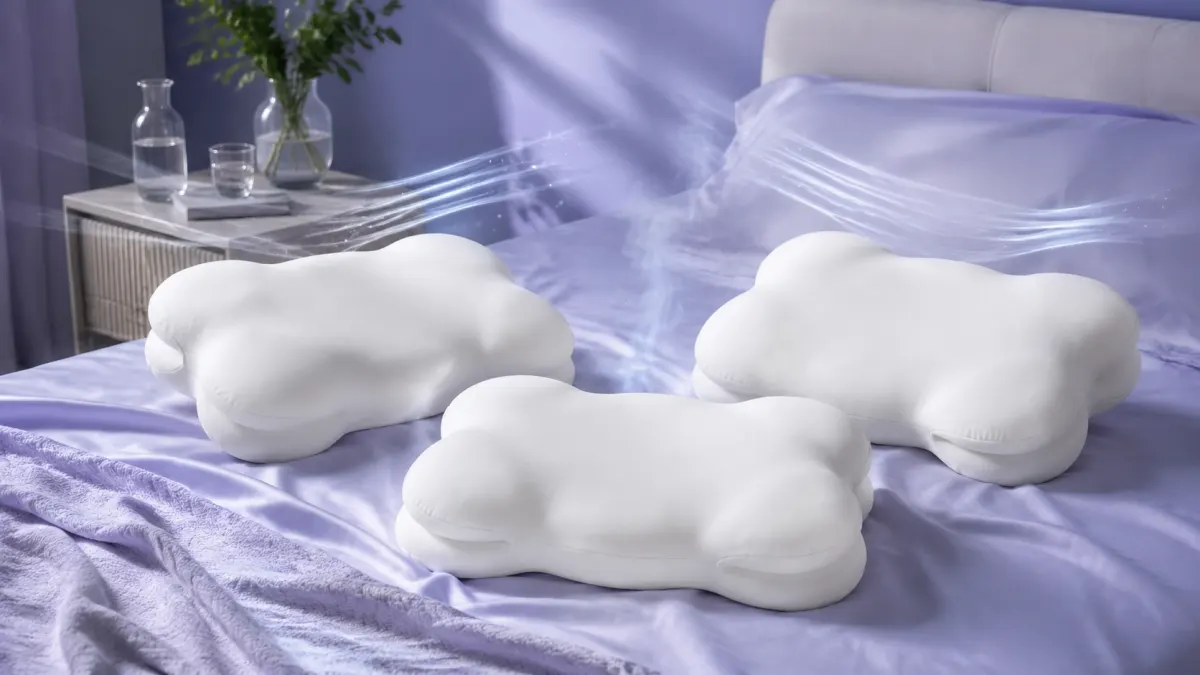
Buying brief
Decide before you shop.
Best fit
Best fit: shoppers who want a soft, supportive Cloud Pillow feel while still checking height, heat, care, and trial fit.
Skip if
Skip it if you dislike shaped foam support and only want a loose, moldable fill.
Feel
Decide whether you want moldable plushness, shaped support, or a middle-ground feel.
Height
Compare usable loft after compression, not just the product name.
Cooling
Ask what happens after the first cool minute.
Care and trial
A comparison is incomplete without cleaning rules and return risk.
Try the Lumuwala fit
Cloud Pillow is the product this guide points back to.
Lumuwala fits if the buyer wants the Cloud Pillow's softer support profile, cleaner policy path, and simple product choice instead of tuning multiple fills or chasing a luxury material label.
See if Cloud Pillow fits hot sleepersCluster links
Keep reading in this sleep path.
The material name is a weak shortcut
A lot of pillow shopping starts with a material fight: memory foam versus latex versus gel. That sounds clean, but the real question is messier. A pillow is a stack of choices. The cover touches your skin. The case goes over the cover. The core either holds shape, moves air, absorbs heat, or does a little of each. Then your sleep position decides how much of your face and neck sink into it.
So the answer is not that one material always cools best. Latex often has better airflow because it is springier and commonly made with open channels. Memory foam often feels warmer when it is dense and slow-moving. Gel can help with first-contact coolness or short heat buffering, but it does not automatically solve heat release. The construction matters more than the label on the box.
Memory foam: stable support, higher heat risk
Memory foam is good at one thing pillow buyers care about: holding a shape around the head and neck. That is why it keeps showing up in support pillows. It spreads pressure, slows movement, and can feel calmer than loose fill. For side and combination sleepers, that stable feel can be useful because the pillow does not drift away every time the sleeper turns.
The heat risk comes from density and surface contact. Slow-response foam can let the head settle deeper, which increases contact area. If the foam is solid and the cover does not breathe, warm air has fewer paths out. Gel-infused memory foam improves that story only if the rest of the design helps heat move. A gel swirl buried in dense foam is not the same as a breathable pillow.
- Best case: ventilated or gel-infused memory foam with a breathable cover and enough loft to keep the face from sinking too far.
- Worst case: dense slow foam, heavy protector, warm room, and a sleeper who buries one side of the face into the pillow.
- Buying cue: ask whether the cooling feature changes the core, the cover, or only the surface feel.
Try the Lumuwala fit
Cloud Pillow is the product this guide points back to.
Lumuwala fits if the buyer wants the Cloud Pillow's softer support profile, cleaner policy path, and simple product choice instead of tuning multiple fills or chasing a luxury material label.
Choose your Cloud Pillow tradeoffLatex: more bounce and often more airflow
Latex usually feels more buoyant than memory foam. Instead of the head slowly melting into the pillow, latex pushes back faster. That can leave more room for movement and can reduce the stuck-in-foam feeling some hot sleepers dislike. Many latex pillows are also made with pinholes or a more open structure, which gives air and humidity a better path than a solid block.
Latex is not automatically cold. A high, firm latex pillow can still feel warm if it presses the jaw and cheek hard or sits inside a thick pillowcase. Latex can also feel too springy for sleepers who want the contour of memory foam. The real advantage is that latex is often easier to ventilate, not that it somehow removes heat from the room.
Gel: useful, but easy to overrate
Gel is the most misunderstood cooling word in pillows. Sometimes it means gel beads or a gel layer in memory foam. Sometimes it means a surface pad. Sometimes it gets paired with phase-change material, which buffers heat over a limited temperature range. These can help, especially at first touch, but the sleeper eventually warms the surrounding material.
That is why gel should be read as one feature, not the whole answer. If the pillow also has airflow, a breathable cover, sensible height, and a trial window, gel can be part of a good cooling setup. If gel is the only cooling detail and the pillow is otherwise a dense slab, expect the cooling effect to fade once the material around it reaches bedroom temperature.
What bedding research adds to the argument
Sleep and bedding research does not hand us a simple ranking of pillow materials. It does show why textile and temperature choices matter. A 2024 systematic review in the Journal of Sleep Research found that bedding and sleepwear fiber types can affect sleep quality by changing skin temperature, body temperature, and thermal comfort, while also noting that studies are hard to compare because designs and populations vary.
That caution is useful. It keeps the material comparison honest. Cotton, wool, polyester, linen, down, foam, latex, and blended textiles do not behave the same way in every room or on every body. Warm conditions, humidity, age, sweat, mattress type, and sleep position can shift the result. A pillow material that is cooler for one person can be wrong for someone who needs a different height or pressure feel.
What our comparison pass found
When we checked ten pillow competitors from primary product pages, the strongest buying signals were not fancy material names. They were plain details: published height, clear cooling mechanism, removable cover care, return policy, and whether the brand said who the pillow fits. Products with a strong material story but vague height guidance were harder to recommend for a specific sleeper.
That matters for Lumuwala because the Cloud Pillow is not trying to be every material at once. It uses adaptive memory foam with cooling gel infusion and a breathable cover, then anchors the fit with a 6 inch medium-firm shape. The material story is memory foam plus cooling support, but the buying story is broader: enough structure for side/back rotation, enough cooling design for warm sleepers, and enough trial time to test it at home.
The practical ranking
For pure airflow, latex often has the edge. For pressure relief and consistent support, memory foam often wins. For first-touch coolness and short-term buffering, gel can help. For real sleep, the winner is the pillow that combines the right height with a credible heat path. A hot side sleeper on a soft mattress may do better with structured gel memory foam than a too-low latex pillow. A back sleeper who hates sink may prefer latex even if the room is only mildly warm.
Use this rule: choose the material after you choose the job. If your main complaint is heat and you like bounce, start with ventilated latex or breathable shredded fill. If your main complaint is neck drop and heat, look at cooling memory foam with enough loft and a breathable cover. If your main complaint is a pillow that feels warm right away, gel or phase-change material may matter more, but it still needs airflow behind it.
The buying mistakes are predictable
The first mistake is buying the coldest surface and ignoring height. That can feel satisfying for one night, then fail because the neck angle is wrong. The second mistake is buying the most supportive pillow and ignoring heat. That can fix morning stiffness while creating a new 3am wake-up. The third mistake is treating a cooling cover as if it changes the whole pillow. Sometimes it does enough. Sometimes it is a thin layer over a warm core.
A cleaner way to shop is to pick two non-negotiables and let the rest be tradeoffs. A broad-shouldered side sleeper might choose height and airflow first, then decide whether the feel should be foam or latex. A back sleeper who hates bounce might choose contour and pressure relief first, then look for gel, perforation, or a lighter cover. A sweaty sleeper might choose moisture handling first and accept a slightly less plush feel.
Lumuwala's place in that map is clear: it is for sleepers who want the pressure consistency of memory foam without giving up on cooling. It is not the bounciest material, and it is not a loose-fill pillow you can reshape every night. The point is a stable cooling-memory-foam feel with a simple fit story. That is the right trade for some hot sleepers and the wrong one for people who want maximum airflow above every other feature.
If two materials are close, choose the one with the lower purchase risk. A fair trial window matters because heat and neck fit are slow findings. The pillow that wins a spreadsheet can still lose the third night.
Where Cloud Pillow does and does not fit
Good fit
Lumuwala fits if the buyer wants the Cloud Pillow's softer support profile, cleaner policy path, and simple product choice instead of tuning multiple fills or chasing a luxury material label.
Not the fit
Lumuwala is not the right fit for every memory foam vs latex vs gel cooling pillow shopper. Do not buy it as a substitute for medical care, as a rigid prescription contour, or as a promise that a pillow alone can fix the room, mattress, or health factors behind poor sleep.
Questions shoppers ask
What is the quick answer for memory foam vs latex vs gel cooling pillow?
Focus on material tradeoffs, support shape, care rules, and trial risk. The right pillow should solve that main job while keeping height, heat, care, and return risk in balance.
Where does Lumuwala Cloud Pillow fit in memory foam vs latex vs gel: which cools best?
It fits when you want a soft support pillow to test at home with the current policy details in view and you are not looking for a rigid medical contour.
How should I test a new pillow?
Use your normal pillowcase, keep bedding stable, and track heat, height, turns, and morning comfort for several nights before deciding.
How many nights should I test the pillow?
Use several normal nights, not one nap or one showroom squeeze. Keep the same pillowcase, mattress, and bedding so the pillow is the main variable.
What should I write down during the test?
Track heat timing, pillow flips, folds, stacking, pressure at the jaw or ear, shoulder load, neck angle, and morning comfort.
Is a higher pillow always better?
No. Side sleepers often need more loft than stomach sleepers, but too much height can tilt the neck upward or push a back sleeper's chin down.
When should I stop self-testing?
Stop and get medical guidance if symptoms are persistent, worsening, nerve-like, tied to injury, or include weakness, numbness, dizziness, or breathing concerns.
What makes an article trustworthy for pillow shopping?
Trust pages that separate fit guidance from medical claims, cite real sources, disclose evidence limits, and avoid invented review counts, ratings, or lab measurements.
Sources
- Li X, Halaki M, Chow CM. How do sleepwear and bedding fibre types affect sleep quality: A systematic review. PubMed PMID: 38627879.
- Okamoto-Mizuno K, Mizuno K. Effects of thermal environment on sleep and circadian rhythm. PubMed PMID: 22738673.
- Lei F, Ren W, Zhang Y, et al. Effects of pillow designs on neck pain, sleep quality and spinal alignment. PubMed PMID: 33895703.
- Fazli F, Farahmand B, Azadinia F, Amiri A. Ergonomic latex pillow randomized controlled trial. PubMed PMID: 32874156.