Sleep pain guide
Can Your Pillow Cause Tension Headaches?
A pillow can contribute to neck and jaw strain, but recurring headaches deserve more care than a one-cause answer.
Quick answer
For tension headaches caused by pillow, the useful answer is to solve feel, support, heat, care, and trial risk without creating a worse tradeoff. Best fit: shoppers who want a soft, supportive Cloud Pillow feel while still checking height, heat, care, and trial fit. Lumuwala Cloud Pillow is worth considering when you want a plush support feel, cooler sleep surface, and a current-policy home trial. Skip the self-test and talk to a clinician if symptoms are persistent, worsening, one-sided, nerve-like, or linked to injury.
Founder and primary Lumuwala byline
Edited by Anya for editorial content editor
Buying brief
Decide before you shop.
Best fit
Best fit: shoppers who want a soft, supportive Cloud Pillow feel while still checking height, heat, care, and trial fit.
Skip if
Skip the self-test and talk to a clinician if symptoms are persistent, worsening, one-sided, nerve-like, or linked to injury.
Pattern
Map the complaint to feel, support, heat, care, and trial risk; do not treat the pillow as a diagnosis.
Position fit
Check side, back, or stomach height separately because each changes neck angle.
Pressure points
Notice jaw, ear, shoulder, skull-base, and arm pressure after several hours.
Care boundary
Persistent or worsening symptoms deserve medical advice before product testing.
Try the Lumuwala fit
Cloud Pillow is the product this guide points back to.
Lumuwala fits when the issue looks like a comfort setup problem: pillow collapse, unstable height, heat-driven turning, or pressure from an old pillow. It should be judged as a comfort product, not a treatment.
See if Cloud Pillow fits your sleepCluster links
Keep reading in this sleep path.
Do not diagnose a headache from a pillow
A pillow can be part of a headache pattern. It should not become the whole explanation by default. Tension-type headaches can involve the head, neck, jaw, shoulders, stress, sleep quality, posture, and muscle sensitivity. If headaches are new, severe, unusual, worsening, or paired with neurological symptoms, fever, trauma, vision changes, weakness, or confusion, stop treating the pillow as the answer and get medical help.
For ordinary recurring morning tightness, the pillow is still worth testing. The useful question is narrow: does your pillow create neck, jaw, or shoulder strain that seems to show up with the headache? If the answer is yes, changing height, firmness, or surface pressure may reduce one trigger. That is different from claiming the pillow caused the headache.
Why the neck can be involved
Tension-type headache research often discusses the neck and surrounding muscles. A review on temporomandibular disorders and cervical dysfunction notes that tension-type headaches can overlap with jaw and cervical problems in ways that complicate diagnosis. Systematic reviews of physical therapy and manual approaches also keep returning to the suboccipital area, cervical movement, and neck-shoulder muscles.
That does not mean a pillow is a treatment. It means neck strain is a plausible part of the morning picture for some people. If the pillow is too high, the chin may tuck and the back of the neck may feel crowded. If it is too low, the neck may hang sideways or backward. If the surface is too hard, jaw and temple pressure may become part of the night.
Try the Lumuwala fit
Cloud Pillow is the product this guide points back to.
Lumuwala fits when the issue looks like a comfort setup problem: pillow collapse, unstable height, heat-driven turning, or pressure from an old pillow. It should be judged as a comfort product, not a treatment.
Use the guide, then test the fitPillow signs worth testing
The clearest pillow clue is timing. If the headache or tight band feeling is worst on waking, then fades as you move, pillow setup belongs on the suspect list. If the headache arrives after work, after skipped meals, during stress, or with screen strain, the pillow may be less central. Morning timing is not proof, but it tells you where to look first.
The second clue is behavior. If you wake with the pillow folded, one hand under your neck, your jaw pressed into a hard edge, or the pillow pushed aside, the setup is not staying neutral. The body may be trying to escape height, pressure, heat, or surface friction. Those small habits are better evidence than the phrase cervical support on a product page.
- Chin tucked on your back: test a lower head height or better neck support.
- Head dropped on your side: test more usable height or a firmer core.
- Jaw or temple pressure: test a softer surface or less face sink.
- Heat plus restlessness: test a cooler cover, case, or pillow core before changing height.
The pillow is only one variable
A bad pillow can share the blame with stress, jaw clenching, alcohol, dehydration, screen posture, sleep loss, or an old mattress. This is why one-night tests are noisy. You can change pillows and still wake with a headache because the main trigger was elsewhere. You can also keep the same pillow and feel better because the week got calmer.
A cleaner test keeps the rest of the night boring. Use the same bedtime, caffeine pattern, room temperature, pillowcase, and blanket weight for several nights if you can. Do not add a new stretching routine, new mattress topper, new supplement, and new pillow on the same day. The goal is not a perfect experiment. The goal is to avoid fooling yourself.
Jaw and temple pressure deserve their own check
A side sleeper may blame neck support when the real irritant is local pressure against the jaw, ear, or temple. A pillow can be the right height and still feel wrong if the top surface is too hard or if the head sinks into a ridge. This is especially easy to miss when the pillow feels supportive in the hand.
Check your face contact in your real side-sleeping position. If the jaw feels squeezed, try a softer case or a pillow with a gentler surface before changing height. If the face sinks so far that breathing feels crowded or the neck rotates, the surface may be too soft even if it feels cozy. Pressure and alignment have to be judged together, especially when the headache starts before breakfast.
A two-week pillow reset
Start with your current pillow for three nights. Write the morning result in one line: headache, neck, jaw, shoulder, heat, and whether you adjusted the pillow. Then change one thing. If the pillow is too low, add a thin folded towel beneath it. If it is too high, remove a layer or try the lower edge. If the surface is too firm, change the case or try a softer top layer without changing height.
After three more nights, compare notes. If one change clearly helps, keep it for a week. If nothing changes, the pillow may not be the main lever. If symptoms worsen, stop the experiment. This is especially true if headaches are frequent, intense, or different from your usual pattern. Pillow testing should be low-risk and reversible, and it should never become a reason to delay care.
Do not chase a new pillow every morning. That creates noise. The better pattern is slow and practical: baseline, one change, three nights, compare. If you buy a new pillow, use the trial window the same way. A return policy is useful only if you test the product with enough consistency to learn something.
What to look for if the pillow is a suspect
Look for stable height first. For side sleepers, the pillow should keep the head level without folding. For back sleepers, it should support the neck curve without pushing the chin forward. For stomach sleepers, it should be very low because the neck is already rotated. A pillow that wins on softness but loses height can still leave you waking tight.
Then look at surface pressure. A headache-prone sleeper may notice jaw, ear, or temple pressure faster than someone else. That does not mean the pillow must be mushy. It means the top surface should give enough to reduce local pressure while the core still holds height. Soft surface, stable core is often a better target than soft everything.
What no pillow can promise
No pillow can promise fewer headaches for everyone. That would be a medical claim pretending to be a bedding claim. The most a pillow can honestly promise is a clearer support job: steadier height, less awkward neck angle, less local pressure, and a cooler surface if heat is part of the waking pattern. Treat the rest as health context first, not product copy or bedtime guesswork.
That is still useful. Removing one source of strain may be enough for some sleepers to wake up calmer. For others, it will reveal that the headache pattern is driven by something else. A good purchase process should leave room for both outcomes, which is why trial windows and careful notes matter. The win is not proving the pillow was guilty. The win is finding out whether the sleep setup is a lever you can safely change, then leaving the rest of the headache question open.
Where Lumuwala fits
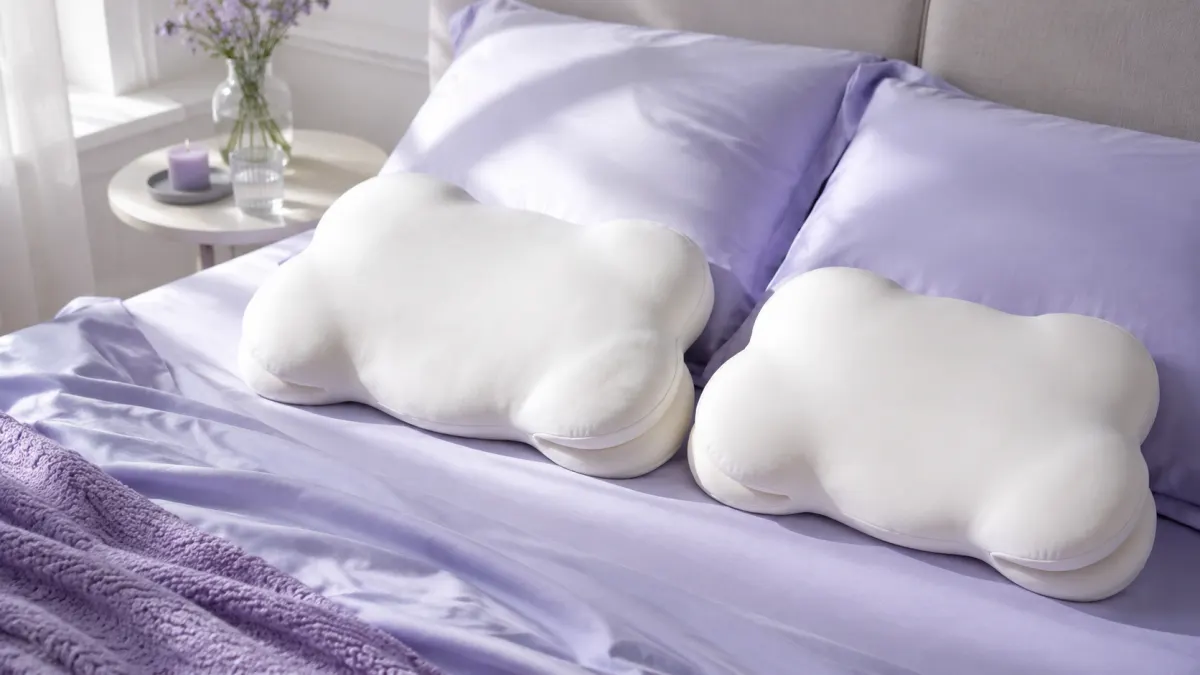
Lumuwala Cloud Pillow makes sense to test when the pattern looks like height collapse, side/back rotation, heat buildup, or a pillow that needs constant folding. The 6 inch medium-firm foam profile gives a stable target, while the gel infusion and breathable cover address the heat side of restless sleep.
It is not a headache treatment, and it is not the right pillow for every headache-prone sleeper. If you need very low back-sleeper height or sleep mostly on your stomach, 6 inches may be too much. If your headache pattern has medical red flags, the right move is care, not another purchase. Use Lumuwala only as a fit test for the pillow part of the problem.
Where Cloud Pillow does and does not fit
Good fit
Lumuwala fits when the issue looks like a comfort setup problem: pillow collapse, unstable height, heat-driven turning, or pressure from an old pillow. It should be judged as a comfort product, not a treatment.
Not the fit
Lumuwala is not the right fit for every tension headaches caused by pillow shopper. Do not buy it as a substitute for medical care, as a rigid prescription contour, or as a promise that a pillow alone can fix the room, mattress, or health factors behind poor sleep.
Questions shoppers ask
What is the quick answer for tension headaches caused by pillow?
Focus on feel, support, heat, care, and trial risk. The right pillow should solve that main job while keeping height, heat, care, and return risk in balance.
Where does Lumuwala Cloud Pillow fit in tension headaches caused by your pillow: what is plausible?
It fits when you want a soft support pillow to test at home with the current policy details in view and you are not looking for a rigid medical contour.
Can a pillow treat pain or numbness?
No. A pillow may reduce one comfort variable, such as height, pressure, or heat, but persistent or nerve-like symptoms should be discussed with a clinician.
How many nights should I test the pillow?
Use several normal nights, not one nap or one showroom squeeze. Keep the same pillowcase, mattress, and bedding so the pillow is the main variable.
What should I write down during the test?
Track heat timing, pillow flips, folds, stacking, pressure at the jaw or ear, shoulder load, neck angle, and morning comfort.
Is a higher pillow always better?
No. Side sleepers often need more loft than stomach sleepers, but too much height can tilt the neck upward or push a back sleeper's chin down.
When should I stop self-testing?
Stop and get medical guidance if symptoms are persistent, worsening, nerve-like, tied to injury, or include weakness, numbness, dizziness, or breathing concerns.
What makes an article trustworthy for pillow shopping?
Trust pages that separate fit guidance from medical claims, cite real sources, disclose evidence limits, and avoid invented review counts, ratings, or lab measurements.
Sources
- Graff-Radford SB, Newman A. Temporomandibular disorders and cervical dysfunction in tension-type headache. PubMed PMID: 12207852.
- Jiang W, Li Z, Wei N, et al. Physical therapy on the suboccipital area in tension-type headache. PubMed PMID: 31083183.
- Gordon SJ, Grimmer-Somers KA, Trott PH. Pillow use and cervical symptoms. PubMed PMID: 21197317.
- Lee E, et al. Effectiveness of manual therapy and acupuncture in tension-type headache. PubMed PMID: 34646653.