Sleep science
REM Sleep and Cooling: What the Research Really Says
REM sleep and temperature are linked, but the research supports careful bedding choices, not miracle claims about a colder pillow.
Quick answer
For REM sleep cooling research, the useful answer is to solve feel, support, heat, care, and trial risk without creating a worse tradeoff. Best fit: shoppers who want a soft, supportive Cloud Pillow feel while still checking height, heat, care, and trial fit. Lumuwala Cloud Pillow is worth considering when you want a plush support feel, cooler sleep surface, and a current-policy home trial. Skip it if you need an ultra-firm contour pillow, an extremely low pillow, or a medical recommendation rather than a comfort trial.
Founder and primary Lumuwala byline
Edited by Anya for editorial content editor
Buying brief
Decide before you shop.
Best fit
Best fit: shoppers who want a soft, supportive Cloud Pillow feel while still checking height, heat, care, and trial fit.
Skip if
Skip it if you need an ultra-firm contour pillow, an extremely low pillow, or a medical recommendation rather than a comfort trial.
Heat source
Decide whether the main problem is feel, support, heat, care, and trial risk.
Air and moisture path
Look for a breathable cover, lighter case, and less face-burying contact.
Height stability
A cooler pillow still fails if it leaves the head too low or too high.
Home test
Judge after several normal nights when the pillow has warmed up fully.
Try the Lumuwala fit
Cloud Pillow is the product this guide points back to.
Lumuwala fits the REM sleep cooling research search when the buyer wants cooling comfort tied to pillow height, not just a chilly first touch. It is strongest for shoppers who rotate between side and back sleep and want to test the heat story at home.
See if Cloud Pillow fits hot sleepersCluster links
Keep reading in this sleep path.
Cooling claims need a short leash
REM sleep is too important to use as decoration in product copy. It is tied to dreaming, brain activity, autonomic changes, muscle atonia, and a different thermoregulatory state from much of non-REM sleep. That does not give any pillow a free pass to claim it increases REM. If a product has not been tested with sleep-stage measurement, the claim should stay out of the copy.
The better question is narrower: can a pillow reduce heat discomfort that wakes a sleeper or makes them keep moving? That is plausible. It is also easier to test at home. You do not need to pretend a pillow controls REM to care about cooling. A warm, damp surface under the head is enough of a problem on its own.
This is where wording matters. A careful brand can say a pillow is designed to manage local heat at the head and neck. It can explain cover fabric, gel infusion, airflow, fill density, and how long the trial lasts. It should not borrow the authority of REM sleep unless the product was actually studied for REM outcomes. Most shoppers do not need that claim anyway. They need a pillow that stops feeling swampy at the exact point they are trying to stay asleep.
REM has a different temperature profile
Thermoregulation changes across sleep stages. Libert's review of thermal regulation during sleep covers that broad relationship, and older physiology work measured body temperature and sweating while sleep stage was recorded. In the sweating study, local sweating response varied with sleep stage and was lowest in REM for a given core temperature compared with slow-wave sleep. That is a body-control finding, not a pillow buying rule.
Still, it helps explain why heat can feel unpredictable at night. The body is not managing temperature the same way in every stage. A blanket that feels fine at lights-out may feel different later. A pillow that feels cool for the first minute may become sticky after it has absorbed heat and moisture. The sleep-stage story is real, but it is indirect.
Try the Lumuwala fit
Cloud Pillow is the product this guide points back to.
Lumuwala fits the REM sleep cooling research search when the buyer wants cooling comfort tied to pillow height, not just a chilly first touch. It is strongest for shoppers who rotate between side and back sleep and want to test the heat story at home.
Test the cooling setup at homeHeat exposure can damage the night
Okamoto-Mizuno and Mizuno's review is the most useful guardrail for shoppers. It reports that real-life heat exposure can increase wakefulness and decrease slow-wave sleep and REM sleep. Humid heat can add thermal load and disturb thermoregulation. The review also notes that bedding and clothing change how heat or cold exposure affects sleep. That matters because a pillow never acts alone.
A hot pillow in a cool room is one problem. A hot pillow inside a warm bedroom with heavy bedding is another. If the whole sleep environment is too warm, a pillow can help only at the local contact point. It cannot pull heat out of the room, lower humidity, or make heavy bedding behave like a lighter blanket.
A small lab study shows why nuance matters
Togo and colleagues compared a constant warm condition with a slowly changing thermal environment in a small controlled study of seven healthy young men. The dynamic condition delayed and lowered the minimum core body temperature and increased slow-wave sleep, while REM duration did not differ. That is not a consumer pillow study, and the sample is small. It is still useful because it separates broad temperature strategy from one-product hype.
The lesson is not that colder is always better. The study worked within a thermoneutral range. Good sleep is usually about comfort and heat loss, not turning the bed into a cold surface. A pillow that feels icy for two minutes but traps heat later may be worse than one that feels neutral and keeps air moving for hours.
For a buyer, this makes the room part of the product test. A pillow cannot be judged fairly if the bedroom swings from cool to overheated, or if one night uses a heavy blanket and the next does not. Keep the setup steady first. Then decide whether the pillow is helping.
What a cooling pillow can honestly do
A cooling pillow can work through a few mechanisms. A breathable cover can reduce clammy surface feel. Gel or phase-change material can buffer heat near first contact. Perforations, shredded fill, or a less dense core can give warm air and humidity more paths out. Stable height can keep the face from sinking too deeply into one warm spot.
Those mechanisms are useful, but none is a REM button. The right claim is comfort: less heat buildup at the head and neck, fewer flips, less face-burying, and a steadier sleep position. If those changes reduce awakenings, the whole night may improve. The sleep-stage effect, if any, is downstream and hard to prove without proper measurement.
The timing of the heat complaint decides which mechanism matters most. If the pillow feels warm almost immediately, the cover, pillowcase, and first-touch materials deserve suspicion. If the pillow feels fine at bedtime and then turns stale around 3am, the issue is more likely heat storage, humidity, or poor airflow through the core. If heat shows up with neck discomfort, the sleeper may be burying the face because the pillow is collapsing or sitting at the wrong height.
Night sweats are not just a shopping category
Night sweats deserve care. Bedding heat, room temperature, alcohol, medications, hormonal changes, infection, anxiety, and other health issues can all be part of the pattern. A cooling pillow may make the surface more tolerable, but it should not be framed as treatment. If sweating is new, drenching, persistent, or paired with fever, weight change, chest symptoms, or other concerning signs, the next step is medical advice.
For ordinary warm-sleeper discomfort, the test is practical. Use lighter bedding, keep the room stable, wash the pillowcase, and try a breathable cover before judging the pillow core. If the surface gets hot quickly, first-touch materials matter. If the heat wakes you after hours, airflow and humidity matter more. The timing of the discomfort is a useful clue.
Do not overread consumer sleep-stage charts
Wearables can show trends, but they are not the same as polysomnography. A graph that says REM went up after a new pillow is not proof the pillow changed REM. It might reflect normal night-to-night variation, alcohol, bedtime, stress, algorithm noise, or a longer sleep window. Treat the chart as a prompt for better notes, not as a verdict.
The useful home metric is simpler: did you wake hot, did you flip the pillow, did you move away from the damp spot, and did your neck feel worse or better in the morning? These are the signals a pillow can reasonably influence. If those improve across several nights, the product is doing its job even when the REM bar on the app bounces around.
If you still want to use the chart, look for boring consistency rather than one heroic night. Did total awakenings drop across a week? Did bedtime and wake time stay similar? Did the room temperature stay in the same range? Did alcohol, late meals, illness, or stress change? A pillow test is already noisy. The more variables you leave moving, the easier it is to credit the pillow for something it did not do.
Where Lumuwala fits
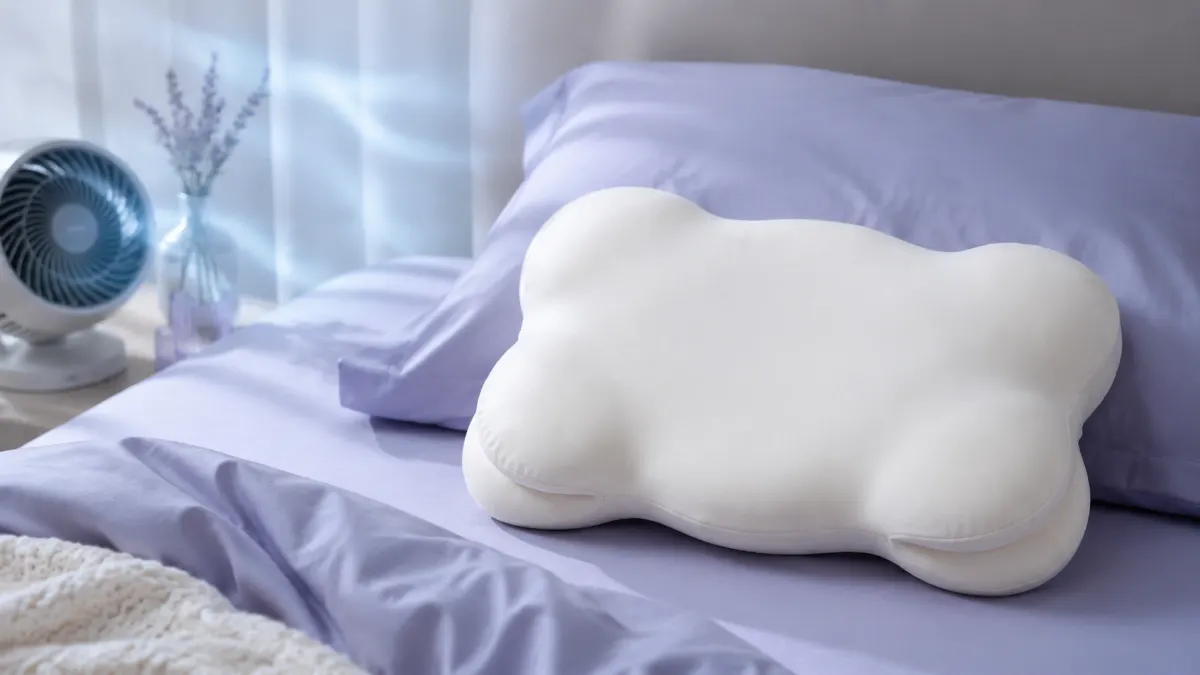
Lumuwala Cloud Pillow is built for sleepers who want cooling and support in the same decision. The gel-infused memory foam and breathable cover target the local heat problem at the head and neck. The 6 inch medium-firm shape targets the support problem that shows up when side and combination sleepers keep folding a pillow for height.
The promise should stay grounded. Lumuwala can be a good test if your pillow feels hot, flat, unstable, or clammy. It is not a REM treatment, and it is not a fix for a bedroom that runs too warm all night. Pair it with room temperature, bedding weight, and a consistent trial window. That gives the pillow a fair test without pretending it controls the whole sleep system.
Where Cloud Pillow does and does not fit
Good fit
Lumuwala fits the REM sleep cooling research search when the buyer wants cooling comfort tied to pillow height, not just a chilly first touch. It is strongest for shoppers who rotate between side and back sleep and want to test the heat story at home.
Not the fit
Lumuwala is not the right fit for every REM sleep cooling research shopper. Do not buy it as a substitute for medical care, as a rigid prescription contour, or as a promise that a pillow alone can fix the room, mattress, or health factors behind poor sleep.
Questions shoppers ask
What is the quick answer for REM sleep cooling research?
Focus on feel, support, heat, care, and trial risk. The right pillow should solve that main job while keeping height, heat, care, and return risk in balance.
Where does Lumuwala Cloud Pillow fit in rem sleep cooling research?
It fits when you want a soft support pillow to test at home with the current policy details in view and you are not looking for a rigid medical contour.
Will a cooling pillow stay cold all night?
No honest pillow stays cold all night. A better goal is slower heat buildup, better moisture handling, and fewer wakeups to flip or rebuild the pillow.
How many nights should I test the pillow?
Use several normal nights, not one nap or one showroom squeeze. Keep the same pillowcase, mattress, and bedding so the pillow is the main variable.
What should I write down during the test?
Track heat timing, pillow flips, folds, stacking, pressure at the jaw or ear, shoulder load, neck angle, and morning comfort.
Is a higher pillow always better?
No. Side sleepers often need more loft than stomach sleepers, but too much height can tilt the neck upward or push a back sleeper's chin down.
When should I stop self-testing?
Stop and get medical guidance if symptoms are persistent, worsening, nerve-like, tied to injury, or include weakness, numbness, dizziness, or breathing concerns.
What makes an article trustworthy for pillow shopping?
Trust pages that separate fit guidance from medical claims, cite real sources, disclose evidence limits, and avoid invented review counts, ratings, or lab measurements.
Sources
- Okamoto-Mizuno K, Mizuno K. Effects of thermal environment on sleep and circadian rhythm. PubMed PMID: 22738673.
- Libert JP. Thermal regulation during sleep. PubMed PMID: 14646797.
- Togo F, Aizawa S, Arai J, et al. Influence on human sleep patterns of changes in the thermal environment. PubMed PMID: 17580602.
- Candas V, Libert JP, Muzet A. Sweating responses and body temperatures during nocturnal sleep in humans. PubMed PMID: 3826411.