Sleep position guide
Best Pillow for Broad-Shouldered Side Sleepers
Broad-shouldered side sleepers often need more stable loft than smaller-frame sleepers, but the mattress still changes the shoulder gap.
Quick answer
For pillow for broad shouldered side sleepers, the useful answer is to solve shoulder pressure, side-sleeper gap fill, and top-arm support without creating a worse tradeoff. Best fit: side or side/back sleepers who need enough loft to avoid head drop without a hard pressure point at the jaw or ear. Lumuwala Cloud Pillow is worth considering when you want a plush support feel, cooler sleep surface, and a current-policy home trial. Skip it if you need an ultra-firm contour pillow, an extremely low pillow, or a medical recommendation rather than a comfort trial.
Founder and primary Lumuwala byline
Edited by Anya for editorial content editor
Buying brief
Decide before you shop.
Best fit
Best fit: side or side/back sleepers who need enough loft to avoid head drop without a hard pressure point at the jaw or ear.
Skip if
Skip it if you need an ultra-firm contour pillow, an extremely low pillow, or a medical recommendation rather than a comfort trial.
Primary job
Name the job first: shoulder pressure, side-sleeper gap fill, and top-arm support.
Sleep position
Side, back, stomach, and combination sleepers should not buy from the same checklist.
Heat and care
A pillow has to feel good after hours and be realistic to maintain.
Trial risk
Use the policy as part of the buying decision, not an afterthought.
Try the Lumuwala fit
Cloud Pillow is the product this guide points back to.
Lumuwala fits when the shopper wants one Cloud Pillow to test for comfort, support, heat, and care instead of building a complicated pillow stack.
Try Cloud Pillow for side/back supportCluster links
Keep reading in this sleep path.
Broad shoulders create a larger gap
Side sleepers need the pillow to fill the space between the mattress and the side of the head. Broad shoulders usually increase that space. If the pillow is too low, the head drops toward the mattress and the neck works all night. If the pillow is tall enough but too soft, it may start right and collapse later.
This is why broad-shouldered sleepers often dislike thin, airy pillows. The pillow feels comfortable at first touch, then the head slowly sinks and the neck bends. A bigger shoulder gap usually needs stable height, not a pillow that disappears under the head by morning.
Body size belongs in the pillow decision
A 2025 side-sleeper pillow-design study identified individualized pillow height using a value calculated from shoulder width and absolute pillow height. It found that cervical curve measures were predicted well by that individualized height relationship. That does not give every shopper a simple number, but it supports the obvious bed reality: shoulder width matters.
Other pillow-shape research measured side-lying shoulder and neck dimensions and found that uniform pillow heights are not suitable for supine and side-lying positions. A systematic review on pillow design also found effects on neck pain, waking symptoms, disability, satisfaction, and alignment. The research points away from one-size advice.
Try the Lumuwala fit
Cloud Pillow is the product this guide points back to.
Lumuwala fits when the shopper wants one Cloud Pillow to test for comfort, support, heat, and care instead of building a complicated pillow stack.
Use the guide, then test the fitThe mattress can shrink or enlarge the gap
A soft mattress lets the shoulder sink. That can reduce the pillow height needed even for a broad-shouldered sleeper. A firm mattress keeps the shoulder high, so the pillow has to fill more space. Two broad-shouldered sleepers can need different pillows because their mattresses behave differently.
Do not measure your shoulder in isolation and order the tallest pillow you can find. Lie on the actual mattress. Notice whether the shoulder settles or stays perched. Then judge the head position. The pillow belongs to the bed system, not to your body measurements alone.
Use the nose-to-sternum check
Lie on your side. The nose, chin, and sternum should point in the same general direction. If the nose points down, the pillow is too low or too soft. If the nose points up, the pillow is too high. Broad-shouldered sleepers often fail the first way: the pillow looks full but compresses too much.
Check after a few minutes, rather than only at lights-out. Foam, fiber, and down-like fills change under weight and heat. A pillow that holds the first minute and collapses by minute ten is not stable enough for this use case.
Height cannot punish the ear and jaw
A tall pillow can solve the neck angle and create a new pressure problem. Ear soreness, jaw pressure, and cheek compression are common reasons broad-shouldered sleepers abandon firm pillows. The goal is a stable core with a surface that gives enough under the face.
If the height is right but the surface feels harsh, try a different case before discarding the pillow. If the surface is soft but the head drops, the core is the issue. Keep those variables separate or every pillow will seem half right and half wrong.
Broad-shouldered sleepers can also get fooled by a pillow that feels good when hugged or squeezed by hand. Hand pressure is not head weight, and it does not show what happens after the shoulder settles into the mattress. Test with the whole side-sleeping posture, not a palm press.
A five-night broad-shoulder test
Track five nights: head level, pillow compression, ear pressure, jaw pressure, shoulder pressure, heat, and whether you fold or stack the pillow. A broad-shouldered sleeper who keeps folding the pillow is often trying to create missing height.
Night one: current pillow. Night two: add a thin towel under the pillow only if the head drops. Night three: remove the towel and test a firmer or taller pillow. Nights four and five: repeat the setup that kept the head level with the least pressure. Do not change the mattress topper during the test.
The useful result is steady height without new pressure. If you get neck relief but wake with jaw soreness, the pillow solved one problem and created another. Keep looking for surface give over stable support.
If the pillow keeps sliding away from the shoulder, that can mean the height is close but the shape is wrong. Some sleepers need a more stable edge under the neck. Others need a case with less slip. Do not add random height before checking whether the pillow is simply moving.
What to look for
Look for enough loft to keep the head level, enough core stability to resist collapse, and enough surface give to avoid ear and jaw pressure. Broad-shouldered sleepers often do better with a medium-firm core than with very soft fill, but firmness without surface give can feel harsh.
Adjustable fill can work if it does not migrate away from the neck. Solid foam can work if the profile fits the mattress. Down-like pillows can work for some broad-shouldered sleepers only when they stay full through the night. If the pillow has to be folded every night, it is probably too low or too soft.
A useful product page should mention shoulder width, mattress softness, side-sleeper support, and return terms. If the page talks only about plushness, it is not answering the broad-shoulder problem.
Common mistakes for broad shoulders
The first mistake is buying for softness first. A soft pillow can feel generous under the face while the head slowly drops. Broad-shouldered sleepers need to know what happens after the pillow compresses, because the neck angle changes when the fill gives way.
The second mistake is stacking two pillows and calling the problem solved. Stacking can create height, but it often creates a ledge. The top pillow slides, the lower pillow bunches, and the head ends up tilted. A single stable pillow is easier to read during a trial.
The third mistake is ignoring the bottom shoulder. If the mattress is too firm, shoulder pressure can make the sleeper tense, which can feel like a pillow problem. If the neck looks level but the shoulder aches, the mattress surface may be louder than the pillow.
Where Lumuwala fits
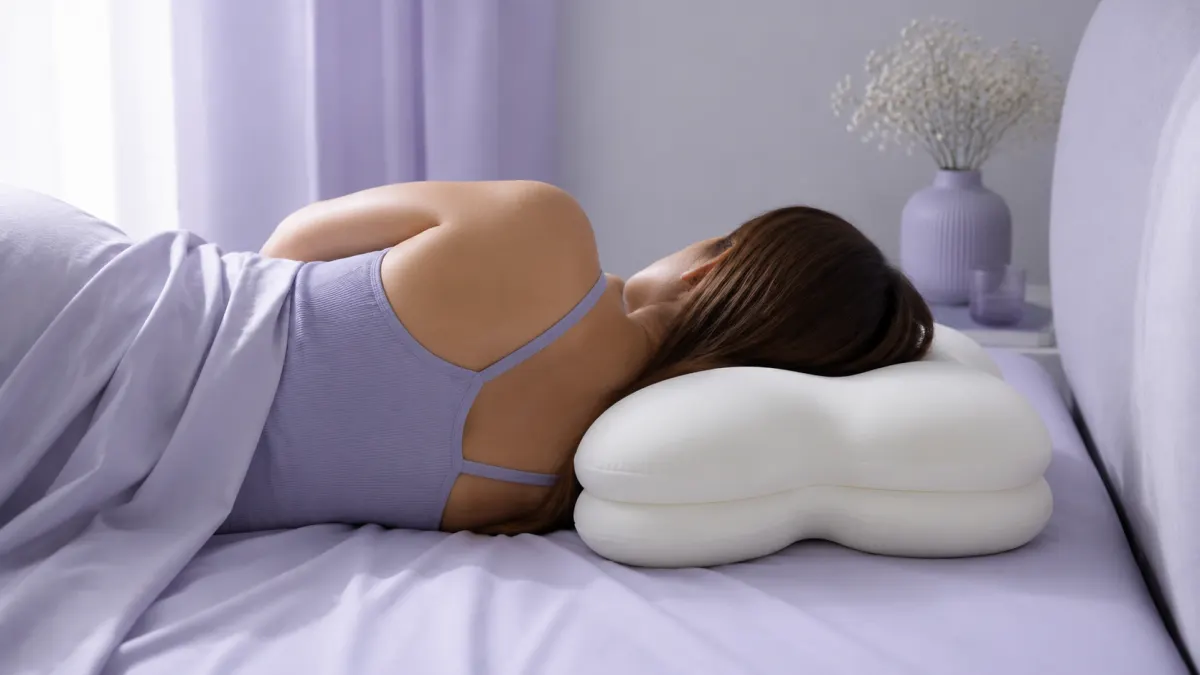
Lumuwala Cloud Pillow is a strong candidate for broad-shouldered side sleepers who need stable medium-firm loft and sleep warm. The 6 inch profile can fill a larger shoulder gap for many side sleepers, while the foam core resists the collapse that makes thin pillows fail.
It may be too tall if your mattress is very soft and your shoulder sinks deeply. It may be too firm if your main complaint is ear or jaw pressure. Test those quickly: head level first, surface pressure second, heat third. Do not stack another pillow underneath during the first trial nights.
The cooling surface matters because broad-shouldered sleepers can stay locked into one side position longer. If heat makes you roll away from the supportive spot, the height test becomes noisy. A cooler cover and stable core can make the trial easier to read.
Keep Lumuwala only if it gives a plain result: level head, supported neck, tolerable face pressure, and fewer heat-driven moves. If it is close but too high, return it instead of training the neck around the mismatch.
If the pillow feels slightly low, check whether the mattress shoulder sink is larger than expected. A firmer mattress can make the same pillow feel lower; a softer mattress can make it feel higher. The bed decides the final fit.
If Lumuwala feels close but the jaw complains, change the case before changing the core. A softer, thinner case can reduce surface bite. If the jaw still complains, the pillow is too firm for that sleeper even if the height looks right.
Broad-shouldered sleepers should also test after the pillow warms up. Some materials soften after body heat settles in. The right pillow should still hold the head level at 3am, after the first ten minutes have passed.
Where Cloud Pillow does and does not fit
Good fit
Lumuwala fits when the shopper wants one Cloud Pillow to test for comfort, support, heat, and care instead of building a complicated pillow stack.
Not the fit
Lumuwala is not the right fit for every pillow for broad shouldered side sleepers shopper. Do not buy it as a substitute for medical care, as a rigid prescription contour, or as a promise that a pillow alone can fix the room, mattress, or health factors behind poor sleep.
Questions shoppers ask
What is the quick answer for pillow for broad shouldered side sleepers?
Focus on shoulder pressure, side-sleeper gap fill, and top-arm support. The right pillow should solve that main job while keeping height, heat, care, and return risk in balance.
Where does Lumuwala Cloud Pillow fit in pillow for broad-shouldered side sleepers?
It fits when you want a soft support pillow to test at home with the current policy details in view and you are not looking for a rigid medical contour.
How should I test a new pillow?
Use your normal pillowcase, keep bedding stable, and track heat, height, turns, and morning comfort for several nights before deciding.
How many nights should I test the pillow?
Use several normal nights, not one nap or one showroom squeeze. Keep the same pillowcase, mattress, and bedding so the pillow is the main variable.
What should I write down during the test?
Track heat timing, pillow flips, folds, stacking, pressure at the jaw or ear, shoulder load, neck angle, and morning comfort.
Is a higher pillow always better?
No. Side sleepers often need more loft than stomach sleepers, but too much height can tilt the neck upward or push a back sleeper's chin down.
When should I stop self-testing?
Stop and get medical guidance if symptoms are persistent, worsening, nerve-like, tied to injury, or include weakness, numbness, dizziness, or breathing concerns.
What makes an article trustworthy for pillow shopping?
Trust pages that separate fit guidance from medical claims, cite real sources, disclose evidence limits, and avoid invented review counts, ratings, or lab measurements.
Sources
- Tian S, Yao C, Wang Y, et al. Individualized optimal pillow height and neck support design for side sleepers. PubMed PMID: 39412632.
- Development and comparative evaluation of new shapes of pillows. PubMed PMID: 24707087.
- Lei F, Ren W, Zhang Y, et al. Effects of pillow designs on neck pain, sleep quality and spinal alignment. PubMed PMID: 33895703.
- Gordon S, Grimmer-Somers K, Trott P. Time to stabilisation of the cervical spine in side lying. PubMed PMID: 23875624.